


Expedition Cruise in Svalbard, Sea Ice, Polar bears and Walrus
At 78 degrees north, the map starts to feel less certain. Glaciers pour down from mountains. Walrus haul out on pale beaches. A dark shape on the ice can stop every conversation on deck, because in Svalbard, that shape might be a polar bear.
An expedition cruise in Svalbard is not a normal cruise with a polar backdrop. It is a voyage built around weather, wildlife, ice, and judgement. The route changes as conditions change. The best days often come from patience: waiting quietly near a walrus colony, scanning sea ice with binoculars, or landing at an old trapper’s hut where Norway’s Arctic history feels close enough to touch.
Svalbard sits between mainland Norway and the North Pole. It is remote, protected, and deeply tied to Norwegian exploration, science, mining, and sovereignty. A voyage here can bring together big Arctic wildlife, stark scenery, and human stories from centuries of whaling, trapping, coal mining, and polar research.
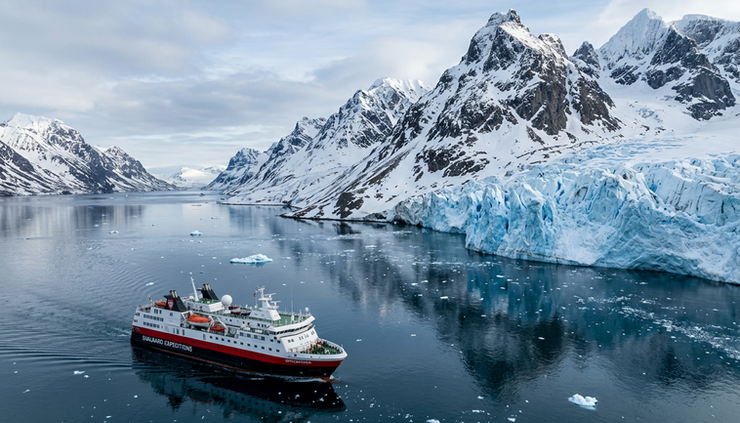
Svalbard is one of the Arctic’s great expedition cruise regions
Svalbard is an archipelago, not a single island. The largest island is Spitsbergen, where most voyages begin and end in Longyearbyen. From there, ships may explore fjords on the west coast, push north towards the pack ice, or attempt a broader circumnavigation when conditions allow.
That word “attempt” matters. In the Arctic, nature writes the final plan. Sea ice, fog, wind, swell, and wildlife protection rules shape each day. A good expedition team does not promise a fixed checklist. Instead, they look for safe windows and meaningful experiences.
A typical day might include:
A Zodiac cruise beneath a glacier front
A shore landing on tundra, with guides carrying safety equipment
A lecture on polar ecology, history, or sea ice
Wildlife watching from the bridge or outer decks
Quiet time near bird cliffs, beaches, or fjord ice
The rhythm is active but not rushed. You spend time outside, often in layers, with binoculars close by. You also learn to look carefully. At first, the Arctic can seem empty. Then the eye adjusts. A white dot becomes a kittiwake. A brown curve becomes a walrus. A cream-coloured shape moving with purpose across the ice changes the mood of the whole ship.
Finding walrus means learning where to look and when to wait
Walrus are among Svalbard’s most memorable animals. They look almost prehistoric, with heavy bodies, long tusks, bristled muzzles, and surprising grace in the water. On land, they gather in haulouts, often lying close together on beaches or low rocky points.
Seeing walrus well depends on distance and respect. Expedition teams approach slowly, usually by Zodiac or from the shore at a set distance. The goal is not to get close at any cost. The goal is to watch natural behaviour without causing stress.
A calm walrus haulout can be wonderfully absorbing. Individuals shift, scratch, grunt, lift their heads, and settle again. In the water, they may surface near each other and raise their tusks above the chop. Their size becomes clear only when they move.
Walrus sightings often happen in places with shallow feeding grounds nearby. They feed mainly on benthic animals, especially clams, which means they depend on productive coastal waters. In Svalbard, guides watch for known haulout areas, fresh tracks, and local conditions.
The best encounters usually have a few things in common:
Quiet approaches that avoid sudden noise or movement
Low expectations that leave room for surprise
Good optics such as binoculars or a long camera lens
Patient observation rather than a quick stop for photos
Walrus were heavily hunted in past centuries, and their presence today carries real weight. Watching them rest on a Svalbard beach is not only exciting. It is also a reminder that Arctic wildlife needs space, protection, and careful management.

Polar bears are the powerful reason everyone keeps watch
Polar bears live throughout Svalbard, but seeing one is never guaranteed. That uncertainty is part of the experience. Every expedition cruise carries a steady sense of watchfulness. Guides scan shorelines. Passengers check ice floes. The bridge team watches for movement where land, sea, and ice meet.
The polar bear is the Arctic’s top predator. In Svalbard, it is fully protected, and responsible operators follow strict rules. Ships and guides avoid disturbing bears, never lure them, and keep a safe distance. Shore landings may be cancelled if a bear appears nearby. That can disappoint people for a moment, then quickly becomes a highlight in itself.
A bear sighting can unfold in many ways. A bear might walk along a glacier front, swim across a bay, sleep on a snow patch, or hunt near the sea ice. Sometimes the view is distant, through binoculars. Sometimes the animal stays in sight for a long time. The finest moments are often quiet: a bear lifting its nose to the wind, stepping across a floe, or disappearing behind a ridge.
Svalbard cruises often place strong focus on bear safety. Guides carry deterrents and maintain lookout during landings. Passengers receive clear instructions before going ashore. These rules are not theatre. They protect people and bears.
A polar bear encounter should feel like a privilege, not a performance. The animal decides the terms. The expedition team decides what is safe. Everyone else watches, learns, and remembers.
The journey to the sea ice is the heart of many voyages
For many travellers, the sea ice is the emotional centre of a Svalbard expedition. It marks the edge of a different world. Open water gives way to scattered floes, then denser ice, depending on season and conditions. The ship slows. The air feels colder. The light changes.
Sea ice is not just scenery. It is habitat. Polar bears use it as a hunting platform. Seals rest and give birth on it. Birds feed near its edges. Algae grow beneath it and support a food web that reaches from tiny organisms to large predators.
Reaching the ice depends on the time of year and the route. In early season, ice may sit closer to the north and east coasts. Later in summer, ships may need to travel farther north to find it. Some years bring heavier ice. Other years bring more open water. That variability is one reason expedition cruising matters here, because flexibility can make the difference between a routine day and an extraordinary one.
Standing on deck at the ice edge can be surprisingly moving. There may be no dramatic event, no bear, no whale, no crack of thunder from a glacier. Just ice, sea, sky, birds, and the low sound of the ship. It gives scale to the Arctic.
It also shows the fragility of the region. The Arctic is warming faster than many other parts of the planet, and sea ice has changed across the wider polar north. A responsible cruise should not treat the ice as a trophy. It should help guests understand what they are seeing and why it matters.

Svalbard’s history links the Arctic closely to Norway
Svalbard’s human history is layered, and much of it connects to Norway’s wider Arctic story. The Dutch navigator Willem Barentsz recorded the islands in 1596, giving the name Spitsbergen to the sharp mountains he saw. After that, whalers from several European nations came north, drawn by bowhead whales and the wealth of Arctic waters.
The remains of old whaling stations still sit in parts of the archipelago. These sites can look sparse today, but they tell a hard story of dangerous work, commercial ambition, and heavy pressure on wildlife. Later came hunters and trappers, including Norwegians and Pomors from the Russian north. Tiny cabins, fox traps, and weathered boats still mark that era.
Coal mining shaped modern Svalbard more than almost anything else. Longyearbyen grew from a mining settlement into the main town and administrative centre. Its name comes from John Munro Longyear, an American businessman linked to early industrial mining there. Norway’s presence strengthened through mining, settlement, mapping, and scientific work.
The legal story changed in the 20th century. The Svalbard Treaty, signed in 1920, recognised Norway’s sovereignty over the archipelago while giving citizens and companies from signatory countries certain rights to commercial activity. Norway took formal administrative control in 1925. This arrangement makes Svalbard unusual: it is part of the Kingdom of Norway, yet governed under a special international treaty framework.
That special status is not abstract when you visit. You see Norwegian place names, laws, search and rescue systems, environmental rules, and public services. You also see international science, historic Russian mining presence, and a polar community shaped by people from many countries.
Longyearbyen reflects this mix. It is Norwegian, Arctic, practical, and global at the same time. There are colourful buildings, snowmobiles, research offices, expedition warehouses, and signs warning people not to leave town without polar bear protection. It is not a themed frontier town. It is a real place at the edge of habitability.
Historic landing sites add depth to the wildlife experience
A Svalbard cruise becomes richer when it balances wildlife with history. A beach with walrus may also sit near old hunting remains. A fjord may hold stories of miners, explorers, scientists, and overwintering trappers. Even a lonely hut can shift the mood of a landing.
Some sites show the ambition and hardship of coal exploration. Others connect to famous polar expeditions and attempts to reach the North Pole. Ny-Ålesund, on the west coast of Spitsbergen, is known today as a research settlement, but it also has links to mining and early aviation history. Roald Amundsen, Umberto Nobile, and other polar figures connect to the broader story of Arctic exploration from this region.
These historic places need careful handling. Many remains are protected cultural heritage. Visitors should not move objects, enter unsafe structures, or treat old sites as props. In the Arctic, decay happens slowly, and a careless footprint can last longer than expected.
The most rewarding guides help join the dots. They explain why people came, how they survived, what they damaged, what they learned, and how Svalbard changed as Norway’s role grew. That context turns the journey from a wildlife search into a fuller Arctic education.

The best time to cruise Svalbard depends on what matters most
Svalbard’s main expedition cruise season runs through the Arctic summer, when daylight lasts around the clock and ships can navigate more freely. Each part of the season has a different feel.
Season period | What it can offer | What to keep in mind |
Late spring to early summer | More snow, colder scenery, sea ice often closer, strong chances for icy atmosphere | Some areas may be blocked by ice |
Mid-summer | Broad daylight, active birdlife, more landing options as snow melts | Ice may retreat northwards |
Late summer | Tundra colours, often more open water, good access to some remote areas | Sea ice may be farther away |
No period guarantees polar bears, walrus, whales, or sea ice. A strong voyage uses the season well rather than pretending nature works to a schedule.
Packing also matters. Weather can shift quickly, even in summer. Good waterproof outer layers, warm mid-layers, gloves, a beanie, and sturdy boots make deck time and Zodiac trips far more comfortable. Many operators provide expedition boots, but check before travelling.
Bring binoculars if possible. Cameras are useful, but binoculars often create the better wildlife experience. They help you watch behaviour, not just capture proof.
Responsible expedition cruising protects what people come to see
Svalbard is not a place for casual impact. Its wildlife, plants, cultural sites, and communities all face pressure from tourism, climate change, and human activity. Good expedition cruising puts responsibility at the centre of the trip.
Look for operators that follow strong Arctic guidelines, brief guests properly, manage wildlife distances, limit group sizes ashore, and treat local rules as the baseline rather than the finish line.
Responsible travellers also play a part:
Keep distance from wildlife, even when an animal seems calm
Follow guide instructions without debate during landings
Stay on marked or instructed paths when visiting sensitive sites
Clean boots and gear when asked, to reduce biosecurity risks
Avoid collecting stones, bones, plants, or historic objects
Choose curiosity over chasing the closest possible photo
This approach does not reduce the adventure. It improves it. Quiet, respectful behaviour often leads to better sightings and a deeper sense of place.
A Svalbard expedition cruise leaves you with more than sightings
The great hope may be polar bears on sea ice. The first thrill may be walrus on a beach. Yet Svalbard tends to stay with people for wider reasons.
It is the silence of a fjord after the engine drops. It is the sight of reindeer grazing under bird cliffs. It is a guide explaining how a rusted cable once served a mining settlement. It is the strange feeling of standing in Norwegian territory closer to the North Pole than to Oslo.
An expedition cruise in Svalbard Discover Walrus Polar Bears Sea Ice and Norway History is really a journey through connections. Wildlife connects to ice. Ice connects to climate. Old huts connect to trade, hunting, mining, and science. Longyearbyen connects this remote archipelago to Norway and the wider world.
Go with hopes, not demands. Pack well. Listen closely. Spend more time looking than photographing. If the Arctic gives you a bear, a walrus haulout, and a morning at the ice edge, count yourself lucky. If it gives you fog, history, birds, glaciers, and a better understanding of the far north, that is still the real Svalbard.


Comments