


Voodoo In West Africa.
Beyond the Mask: Understanding Vodun in Benin and Togo
There are some journeys where the landscape is the story.
Others are about wildlife, adventure or the remoteness of the places you reach.
And then there are journeys where the people, beliefs and traditions you encounter open a window into an entirely different way of understanding the world.
Benin and Togo are places where that happens.

For centuries, communities across this part of West Africa have practised spiritual traditions that have shaped their relationship with nature, ancestors, community and the unseen world. Today, Vodun remains a living part of cultural life, particularly in Benin and Togo.
To understand it properly, however, it is important to move beyond the word “Voodoo” and the often inaccurate images that have surrounded it in popular culture.
Vodun is not about Hollywood stereotypes, curses or “black magic”.
It is a complex collection of spiritual beliefs, rituals, social practices and relationships with deities and ancestors. Different communities practice it in different ways, and there is no single universal Vodun tradition.
And once you begin to understand that,
the ceremonies, dances, masks and sacred places you encounter in Benin and Togo become much more fascinating.

So, what is Vodun?
At its heart, Vodun is concerned with the relationship between human beings, the natural world, spiritual forces and ancestors.
UNESCO describes Beninese Vodun as a tradition combining beliefs in deities, ritual practices and a way of life. Its spiritual world includes deities associated with elements of nature, including water, earth, air and fire. Ancestors also occupy a central position and are believed to remain connected to the lives of the living.
There is also a supreme creator in some Vodun traditions, while particular spirits or deities act as intermediaries between the human and spiritual worlds.
The important point is that Vodun is not necessarily understood as a distant religion that is practiced only inside a temple.
It can be woven into everyday life.
It can influence ceremonies, family traditions, healing, festivals, relationships with nature and the way communities understand important events.
The World of the Spirits
One of the most fascinating aspects of Vodun is its understanding of the spiritual world.
Rather than a simple division between “the living” and “the dead”, ancestors can remain an important presence within community life.
They may be remembered, honoured and approached through ceremonies and rituals.
UNESCO notes that ancestors are believed to influence the lives of the living through blessings or curses, with ancestral worship involving rituals intended to honour them and communicate with the afterlife.
Then there are the Vodun deities themselves.
Different traditions recognise different spiritual beings, and their roles can be associated with aspects of the natural world.
For example, UNESCO’s documentation of Beninese Vodun identifies:
* Sakpata, associated with the earth
* Dan, associated with air
* Hêbiosso, associated with fire
* Tôhôssou, associated with water
These relationships with nature help explain why the natural environment can be such an important part of Vodun spirituality.
The spiritual world is therefore not simply somewhere “else”.
It can be understood as existing alongside the physical world.

How is Vodun Practised?
There is no single way to practise Vodun.
Practices vary considerably between communities and traditions.
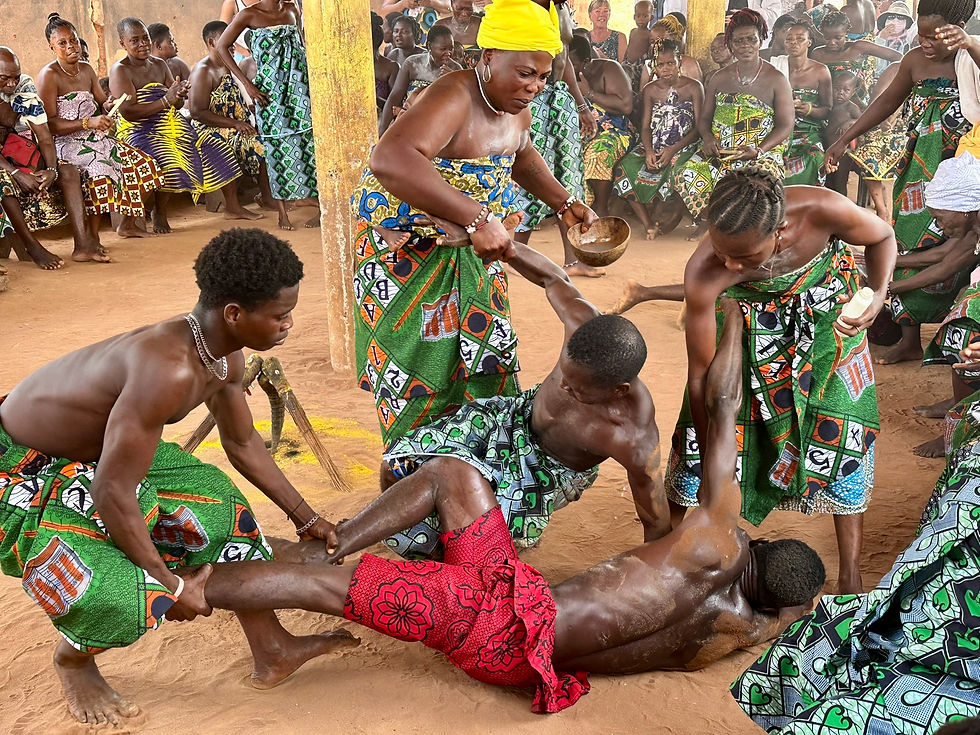
Ceremonies may involve drumming, singing, dancing, offerings, prayer, costumes, masks and ritual objects.
Music is particularly important.
The sound of drums can gradually transform an ordinary gathering into something much more intense. Rhythms build, dancers respond and the atmosphere changes.
For participants, the dance can have spiritual meaning rather than simply being a performance.
Certain dances may be associated with particular spirits, ceremonies or communities. Costumes and masks can represent spiritual beings or ancestral traditions, while movement and rhythm can form part of the relationship between people and the spiritual world.
For an expedition traveller witnessing this for the first time, it can be difficult to know exactly what you are seeing.
That is why local knowledge matters.
The most rewarding experience isn’t simply watching the dance.
It is understanding why the dance is taking place, who it represents and what it means to the people performing it.
The Power of Dance
One of the most spectacular aspects of visiting Benin and Togo is seeing how spirituality, music and dance come together.
Gèlèdè
In Benin, Gèlèdè is one of the most visually extraordinary masked traditions.
Performers wear elaborate costumes and carved wooden masks, accompanied by drumming, singing and dancing.
But Gèlèdè is much more than a colourful performance.
The tradition has strong connections with community values and the power and importance attributed to women, particularly elder women.
The masks themselves can depict people, animals, objects and symbolic imagery.
Watching the dancers move beneath these masks is captivating, but understanding the symbolism gives the experience another dimension.
UNESCO has recognised the Oral Heritage of Gèlèdè as intangible cultural heritage.
Zangbéto
In Togo, one of the most striking traditions you may encounter is Zangbéto.
These tall, elaborate masked figures are traditionally associated with spiritual guardianship and protection.
Their costumes completely conceal the person beneath them, and when they begin to move, spin and dance to the rhythm of drums, the effect can be extraordinary.
To an outsider, it can look almost impossible.
But the important part isn’t simply trying to work out what is underneath the costume.
It is understanding what Zangbéto represents within the community and the spiritual traditions surrounding it.

Vodun Ceremonies
Some of the most powerful experiences are ceremonies where dance, music and spirituality come together.
The atmosphere can build gradually.
Drums begin.
People gather.
Voices rise.
Dancers move with increasing intensity.
Costumes and masks appear.
And what began as music and movement becomes something much deeper.
For those participating, the ceremony may involve communication with spiritual forces, honouring particular deities or ancestors, asking for protection or marking an important event.
Visitors may be permitted to observe particular ceremonies, but the experience should always be approached with respect.
These are living religious traditions, not performances created solely for tourists.
The Fetish Market of Lomé
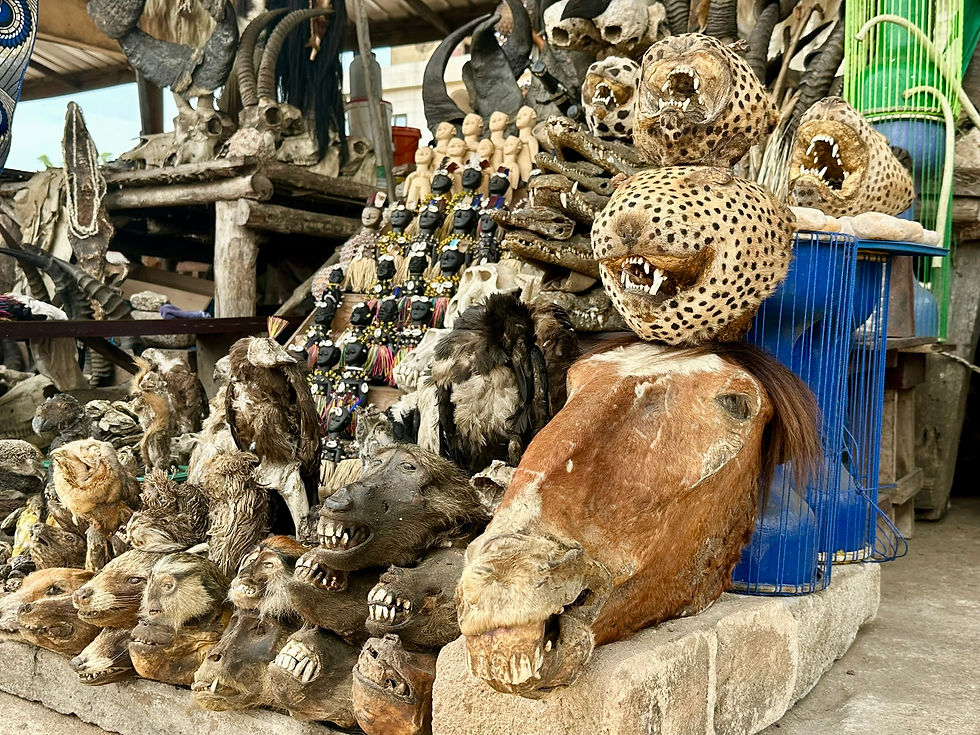
Another fascinating — and sometimes confronting — part of exploring Vodun culture is a visit to the Akodésséwa Fetish Market in Lomé.
The word “fetish” can be misleading to a modern visitor.
Within the context of the market, objects and materials are connected with traditional spiritual practices and forms of traditional medicine.
You may encounter herbs, carved objects, animal-derived materials, statues and other items used by traditional practitioners.
For somebody encountering the market for the first time, some of it can be difficult to understand.
But rather than viewing it simply as something strange or macabre, it is much more interesting to ask what these objects mean within the belief system.
What is their purpose?
Who uses them?
What traditions have been passed down?
What does healing mean within this spiritual framework?
Suddenly, the market becomes less about the objects themselves and much more about understanding an alternative system of knowledge.
From West Africa to the Caribbean and the Americas
Perhaps one of the most fascinating parts of Vodun’s history is that its influence did not remain in West Africa.
It travelled.
And it travelled under some of the most tragic circumstances in human history.
During the transatlantic slave trade, millions of Africans were forcibly transported to the Americas. Among them were people from the regions that are now Benin, Togo, Nigeria and surrounding areas.
They did not leave their cultures behind.
They carried languages, music, food, stories, spiritual beliefs and traditions with them.
UNESCO notes that Vodun originated in West Africa and came to be practised in places where enslaved people from the region were deported.
This forced migration created new cultural worlds.
African spiritual traditions encountered European Christianity and the cultures of other African peoples who had also been displaced.
Over generations, traditions changed, adapted and merged.
One of the most famous examples developed in Haiti, where Haitian Vodou emerged from West and Central African spiritual traditions alongside influences from Roman Catholicism and the particular circumstances of colonial slavery.
This is why it is important not to treat Beninese Vodun and Haitian Vodou as identical.
They are related through history, but they developed in different environments and have their own beliefs, ceremonies, spirits and traditions.
Similar processes occurred elsewhere.

African religious traditions contributed to spiritual practices and cultural traditions throughout the Caribbean and parts of Latin America, including Brazil and Cuba, where they developed into distinct religious and cultural forms.
The connection between West Africa and the wider African diaspora can therefore be seen not simply as a historical footnote, but as a living cultural legacy.
The History Behind the Journey
There is also a darker history that cannot be separated from this story.
Benin’s coastal region, particularly around Ouidah, became deeply involved in the transatlantic slave trade.
The historic Kingdom of Danxomè (Dahomey) played a significant role in regional slave trading during the eighteenth and nineteenth centuries. Ouidah became one of the major ports associated with the trade, and the routes taken by enslaved people from inland areas towards the coast remain part of the historical landscape.
This means that visiting Ouidah can bring together two interconnected histories.
On one side is the remarkable cultural and spiritual heritage of the region.
On the other is the devastating story of forced migration and slavery.
The two cannot really be separated.
The same coastline from which people were forcibly transported across the Atlantic also became part of the route through which West African culture reached the Caribbean and the Americas.
That makes the journey particularly powerful.
Why Experiencing Vodun Matters
Perhaps the greatest mistake a traveller can make is to arrive expecting something mysterious and exotic and leave without understanding the people behind it.

Vodun is not simply masks.
It isn’t just drums.
It isn’t just dancing.
And it certainly isn’t the Hollywood version of “voodoo”.
It is a living spiritual and cultural tradition that has survived enormous historical upheaval.
It connects people with ancestors.
It connects communities with nature.
It provides ways of understanding spirituality, healing, protection and the unseen world.
And its influence can be traced far beyond Benin and Togo — across the Atlantic and into the cultures of the Caribbean and the Americas.
For an expedition traveller, that is what makes the experience so compelling.
You can stand in Ouidah and watch a ceremony surrounded by drums and dancers.
You can encounter masked traditions whose meanings stretch back generations.
You can visit the Akodésséwa market and learn about traditional spiritual practice.
You can listen to local people explain their beliefs.
And then you can begin to understand that the story you are seeing in West Africa is also connected to a much bigger global story — one that reaches across the Atlantic and continues to influence cultures thousands of kilometres away.
That is the real value of cultural expedition travel.
Not simply seeing something unfamiliar.
But taking the time to understand it.
To listen to the people who practise it.
And to leave with a deeper appreciation of how history, spirituality and culture have shaped the world we live in today.


Comments