


Where to Find Every Penguin Species
Penguins are often imagined as one Antarctic crowd, but their map is far wider and stranger than that. Some live on sea ice at the bottom of the world. Others nest in deserts, temperate forests, volcanic islands, and even on the equator.
Seeing every penguin species is possible in theory, but it is not one simple voyage. It takes a patchwork of expedition cruises, small-ship wildlife voyages, and, in a few places, carefully managed shore visits before or after a cruise. The reward is a global wildlife quest that stretches from the Weddell Sea to the Galápagos, from South Africa’s beaches to the subantarctic islands south of New Zealand.
Most modern checklists recognise 18 penguin species, although taxonomy can vary, especially around rockhopper penguins. This guide follows that common 18-species list and shows where each one lives, plus the kind of journey that gives you the best chance of seeing it.

The big picture of penguin geography
Penguins live only in the Southern Hemisphere, but they are not all ice specialists. Their range falls into several broad zones:
Antarctica and the subantarctic
Emperor, Adélie, chinstrap, gentoo, king, macaroni, royal, and several rockhopper populations.
Southern South America
Magellanic, Humboldt, southern rockhopper, gentoo, king, and macaroni in different areas.
Africa
African penguins along the coasts of South Africa and Namibia.
Australia and New Zealand
Little, yellow-eyed, Fiordland, Snares, erect-crested, royal, and others on remote islands.
The Galápagos
The world’s only penguin regularly found north of the equator.
No single itinerary covers them all. A serious attempt usually combines these journeys:
An Antarctic Peninsula, Falklands, and South Georgia expedition.
A Weddell Sea or Ross Sea expedition for emperor penguins.
A New Zealand subantarctic islands cruise, often including the Snares, Auckland Islands, Campbell Island, and sometimes Macquarie Island.
A Galápagos small-ship expedition.
A South America Pacific coast voyage, or a Peru and Chile land-and-sea journey.
A South Africa coastal wildlife extension.
That is a big undertaking, but it also makes the quest so compelling. Each penguin species belongs to a very particular world.
Every penguin species and where to find it
Penguin species | Main range | Best expedition-style route |
Emperor penguin | Antarctic sea ice, especially Weddell and Ross Sea regions | Weddell Sea trips to Snow Hill area, or Ross Sea expeditions |
King penguin | South Georgia, Falklands, Crozet, Kerguelen, Prince Edward Islands, Macquarie Island | Falklands, South Georgia, and Antarctic Peninsula cruise |
Adélie penguin | Antarctic coast and islands | Antarctic Peninsula, Weddell Sea, or Ross Sea cruise |
Chinstrap penguin | Antarctic Peninsula region, South Shetlands, South Orkneys, South Sandwich Islands | Antarctic Peninsula and South Shetlands cruise |
Gentoo penguin | Antarctic Peninsula, Falklands, South Georgia, some subantarctic islands | Falklands, South Georgia, and Antarctic Peninsula cruise |
Macaroni penguin | South Georgia and other subantarctic islands | South Georgia expedition cruise |
Royal penguin | Macquarie Island | New Zealand subantarctic and Macquarie Island cruise |
Northern rockhopper penguin | Tristan da Cunha, Gough Island, Amsterdam and St Paul Islands | Specialist South Atlantic or Indian Ocean expedition |
Southern rockhopper penguin | Falklands, southern Chile and Argentina, subantarctic islands | Falklands cruise or Patagonia expedition |
Snares penguin | The Snares Islands, south of New Zealand | New Zealand subantarctic islands cruise |
Erect-crested penguin | Antipodes and Bounty Islands, with some on other New Zealand subantarctic islands | Specialist New Zealand subantarctic cruise |
Fiordland penguin | South-west New Zealand and Stewart Island region | New Zealand coastal or subantarctic cruise |
Yellow-eyed penguin | South-east New Zealand, Stewart Island, Auckland and Campbell Islands | New Zealand subantarctic cruise or Otago extension |
Little penguin | Southern Australia, Tasmania, New Zealand | Australia or New Zealand coastal trip |
African penguin | South Africa and Namibia | South Africa coastal wildlife trip, often as a cruise extension |
Magellanic penguin | Argentina, Chile, Falklands | Patagonia, Falklands, or South Atlantic cruise |
Humboldt penguin | Peru and northern Chile | Peru and Chile coastal expedition |
Galápagos penguin | Galápagos Islands, especially western islands | Galápagos small-ship expedition cruise |
Antarctica is where the classic polar species live
If the aim is to see penguins in their most dramatic icy setting, Antarctica is the obvious place to start. Several species can be seen on a single expedition, especially on longer sailings that include the Falkland Islands and South Georgia.
Emperor penguin
The emperor penguin is the great prize of Antarctic penguin watching. It breeds on sea ice during the Antarctic winter, far from the standard visitor routes. That makes it one of the hardest species to see.
The best-known expedition option is a voyage towards the Snow Hill Island area in the Weddell Sea, where ships may use helicopters or long-range Zodiac operations depending on conditions and permissions. Ross Sea expeditions can also offer a chance, though sightings are never guaranteed.
Emperors are not a casual add-on. They require a specialist itinerary, a flexible schedule, and acceptance that ice conditions rule everything.
Adélie penguin
Adélies are the bold, classic black-and-white Antarctic penguins of ice floes and rocky colonies. They live around much of the Antarctic coastline and nearby islands.
You can see them on many Antarctic Peninsula voyages, especially those that push farther south, and on Weddell Sea or Ross Sea sailings. They often share the stage with icebergs, skuas, seals, and a constantly changing frozen seascape.

Chinstrap penguin
Chinstrap penguins are easiest to identify by the fine black line under the chin. They breed in large colonies around the Antarctic Peninsula region, including the South Shetland Islands.
Many standard Peninsula cruises visit chinstrap sites when landing conditions allow. They are lively, noisy birds, and their colonies can feel intensely active during the breeding season.

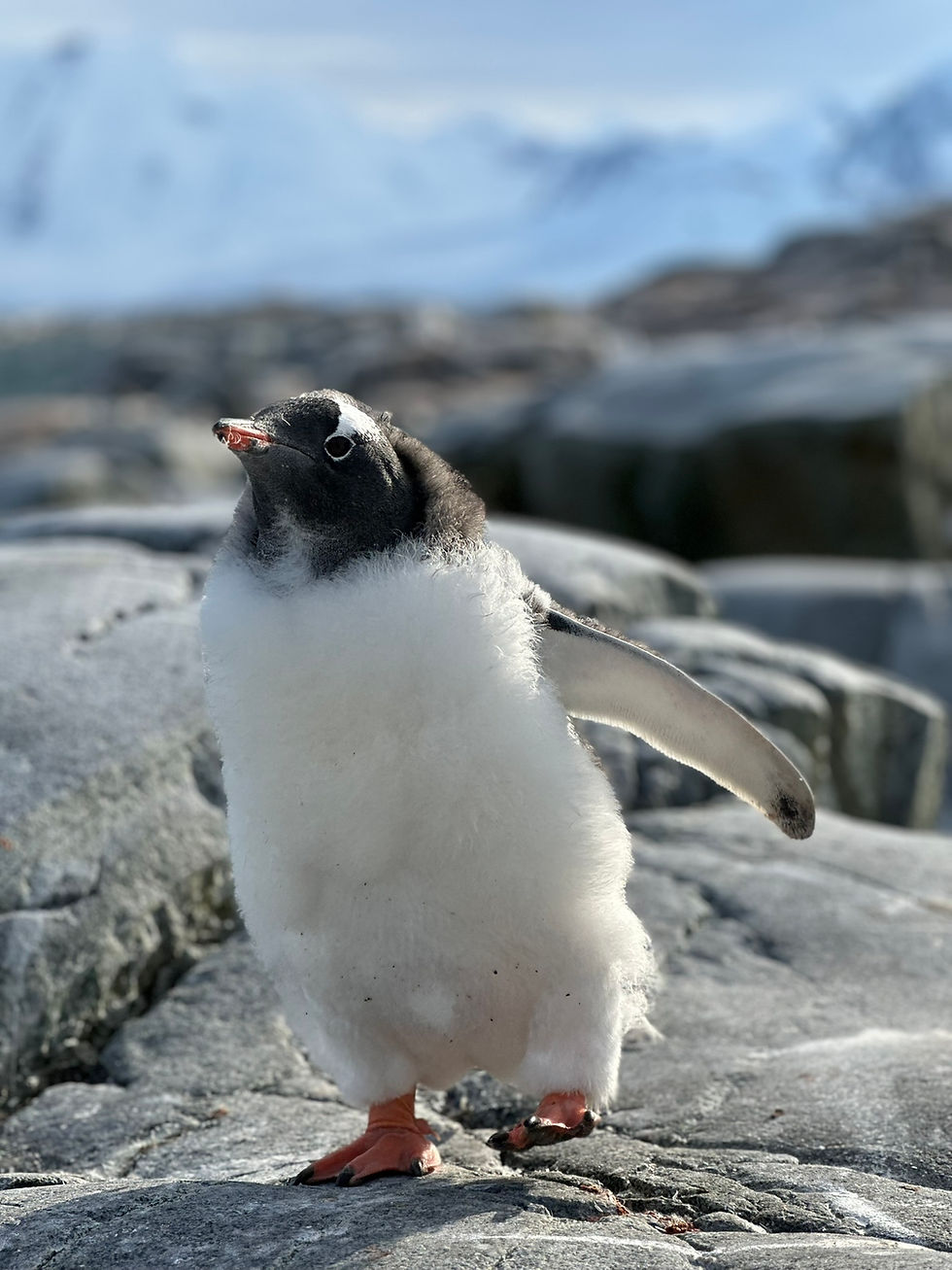
Gentoo penguin
Gentoos have orange bills, white head patches, and a curious, busy manner around their nests. They live on the Antarctic Peninsula, the Falklands, South Georgia, and other subantarctic islands.
They are one of the most commonly seen penguins on classic expedition routes. If you take a voyage combining the Falklands, South Georgia, and Antarctica, gentoo sightings are very likely.
South Georgia and the Falklands are penguin heavyweights
For sheer density and drama, South Georgia is one of the finest penguin destinations on Earth. The Falklands add

grassland colonies, southern rockhoppers, Magellanic burrows, and easy photographic variety.
King penguin
King penguins are the second-largest penguins after emperors. They do not need sea ice to breed, and their great colonies create some of the most memorable wildlife scenes on the planet.
The most famous expedition destination is South Georgia, where vast colonies gather on beaches and glacial plains. The Falklands also have king penguins, though in far smaller numbers. Macquarie Island, south of New Zealand, is another major site.
A South Georgia landing, if weather allows, can be one of the defining moments of a penguin-focused journey.
Macaroni penguin
Macaroni penguins have golden crest feathers and an energetic, scrambly approach to life on rocky shores. They breed on several subantarctic islands, including South Georgia.
Many South Georgia itineraries may encounter macaroni penguins, though access depends on sea state, biosecurity rules, and landing permissions. They are less straightforward than gentoo or king penguins, but South Georgia gives a strong chance.
Southern rockhopper penguin
Southern rockhoppers live up to their name, moving across steep, rocky terrain with springy jumps. They breed around the Falklands, southern South America, and some subantarctic islands.
The Falkland Islands are one of the best expedition cruise destinations for southern rockhoppers. They often nest near albatrosses and cormorants on rugged cliffs and grassy slopes.

Magellanic penguin
Magellanic penguins breed in burrows and under shrubs along the coasts of Argentina and Chile, and also in the Falklands. They are common on many Patagonia and Falklands itineraries.
They feel quite different from ice-associated penguins. Instead of glaciers and sea ice, expect coastal scrub, wind-shaped grass, and sandy or pebbly shores.
New Zealand’s subantarctic islands hold some of the rarest penguins
A New Zealand subantarctic expedition is essential for anyone trying to see every penguin species. These islands are remote, strictly protected, and weather-exposed. Landings are never certain, but the rewards are exceptional.
Royal penguin
Royal penguins breed almost entirely on Macquarie Island, an Australian territory between New Zealand and Antarctica. They resemble macaroni penguins but have a pale face.
Macquarie Island appears on some longer subantarctic expeditions from New Zealand or Australia. These voyages may also encounter king penguins and gentoo penguins, making the island unusually rich for penguin watchers.
Snares penguin
The Snares penguin breeds only on the Snares Islands, south of New Zealand. Landings are generally not allowed because the islands are so protected, but expedition cruises may offer Zodiac cruising offshore if conditions permit.
That means the experience is different. You are not walking through a colony. You are watching from the water, looking for birds on rocks, in the surf, and porpoising near the boat.
Erect-crested penguin
Erect-crested penguins breed mainly on the Antipodes Islands and Bounty Islands. These are among the more difficult penguin islands to reach, not because they are unknown, but because they are remote, rough, and visited by only a small number of specialist expeditions.
For this species, choose a New Zealand subantarctic itinerary that specifically names the Antipodes or Bounty Islands. Even then, the sea has the final say.
Fiordland penguin
Fiordland penguins, also called tawaki, live along the wet, forested south-west coast of New Zealand and around Stewart Island. They are one of the few penguin species associated with temperate rainforest.
They can be searched for on New Zealand coastal expeditions, especially those visiting remote parts of Fiordland. Sightings can be challenging because the birds are shy and the coastline is complex.
Yellow-eyed penguin
Yellow-eyed penguins live in south-eastern New Zealand, Stewart Island, the Auckland Islands, and Campbell Island. They are endangered and sensitive to disturbance, so responsible viewing matters.
Some New Zealand subantarctic cruises visit areas within their range. Otago Peninsula, near Dunedin, is also known for managed viewing opportunities, which can work well before or after a voyage.
Little penguin
The little penguin is the smallest penguin species. It lives around New Zealand, southern Australia, Tasmania, and nearby islands.
It is often easier to see on a land-based evening visit than on an expedition cruise, but coastal voyages in Australia or New Zealand may pass through its range. If the goal is a complete penguin list, a managed evening viewing site can fill this gap neatly and with low disturbance.


Comments